 JEE
JEE
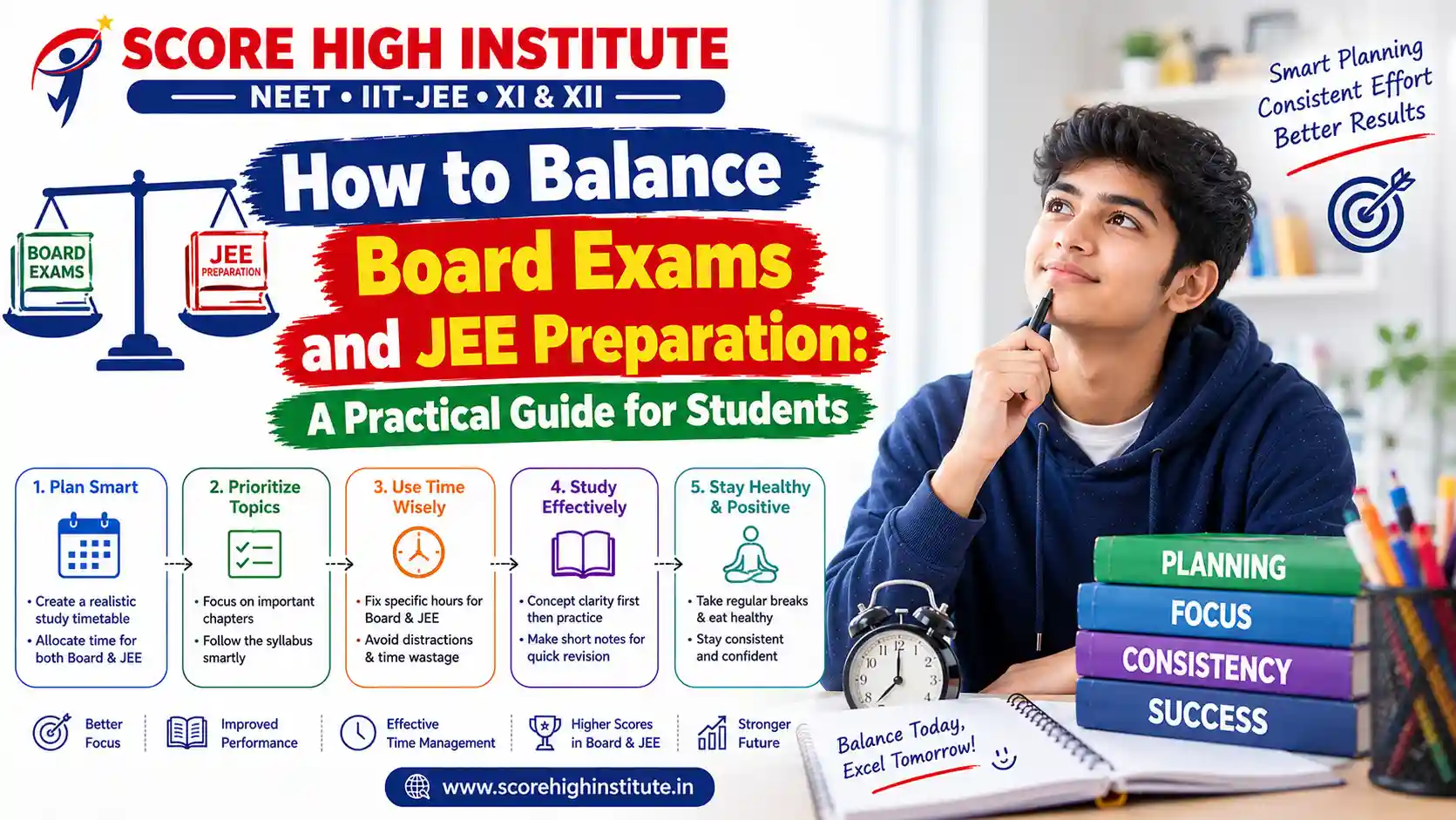
How to Balance Board Exams and JEE Preparation: A Practical Guide for Students
Every engineering aspirant in Class 12 faces a common dilemma: should the main focus be board exams or JEE?
Many students feel stuck between two worlds. On one side, school teachers emphasize descriptive answers, board practicals, and neat handwriting. On the other side, entrance exam mentors emphasize speed, numerical accuracy, and multiple-choice tricks. When students treat these two exams as completely separate battles, stress builds up quickly.
The truth is much simpler: JEE and board preparation are not opposites. They are two branches of the very same tree. Both exams test your understanding of Physics, Chemistry, and Mathematics. The only real difference lies in how that understanding is evaluated.
If you learn how to align both tracks into a single learning path, you can score 90% or higher in your boards while securing a top percentile in JEE. This comprehensive guide breaks down a realistic, step-by-step approach to managing both exams without burning out.
Understanding the Overlap Between Board Exams and JEE
To eliminate anxiety, you must first look at the syllabus. The syllabus for CBSE or state Class 12 boards and JEE Main is almost identical. Both exams are derived directly from the fundamental core of Class 11 and Class 12 science.
Here is how the two exams actually differ:
- Board Exams: They evaluate your conceptual clarity, your ability to explain theories step-by-step, write derivations, draw labeled diagrams, and present clean mathematical proofs.
- JEE Main: It evaluates your ability to apply the exact same concepts to unfamiliar, multi-step numerical problems within strict time limits.
When you study a chapter for your boards, you are building the foundation. When you solve advanced problems for JEE, you are testing that foundation under pressure. Therefore, successful JEE preparation with Class 12 boards does not mean doubling your study hours; it means changing how you study every single topic.
Why NCERT Is Your Best Friend for Both Exams
Students often make the mistake of setting aside standard textbooks to jump directly into heavy reference books. This is a risky trap.
NCERT textbooks are the official anchor for both your board exams and JEE Main. If you analyze past question papers of JEE Main—especially for Chemistry and modern Physics—you will find that several direct questions are lifted straight from NCERT lines, graphs, and summary tables.
To make NCERT work for both goals simultaneously:
- Read Line-by-Line: Treat NCERT chapters as your base notes. Highlight key definitions, exceptions, and highlighted boxes.
- Solve Every In-Text Example: Board exams frequently pick numerical questions directly from solved examples. JEE Main questions often tweak these exact examples to test edge cases.
- Complete the End-of-Chapter Exercises: The back exercises of NCERT test descriptive logic. Writing out these answers by hand trains you for the presentation required in board papers.
Once an NCERT chapter is thoroughly clear in your mind, moving on to previous years' JEE questions becomes significantly smoother.
The Core Strategy: How to Prepare for Boards and JEE Together
The secret to managing two demanding goals is integration rather than separation. Instead of dividing your days into "Board Days" and "JEE Days," combine both modes of thinking within every study session.
Here is a practical, four-step routine you can apply to every single chapter:
1. Build the Concept (Boards & JEE)
Start by attending lectures or reading the textbook to understand the fundamental law, mechanism, or theorem. Focus purely on why something happens.
2. Practice Theory and Derivations (Boards)
Immediately close your notes and write out the formal derivation or scientific definition in your own words. Practice drawing the associated diagrams or circuit graphs neatly. This locks in your board preparation while it is fresh.
3. Move to Direct Numerical Application (JEE Main)
Solve 15 to 20 standard single-concept formula problems. This builds your calculation speed and helps you spot how board-level theories translate into entrance-level questions.
4. Tackle High-Level MCQs (JEE Advanced & Main PYQs)
Once standard questions feel comfortable, attempt 20 to 30 past-year questions that combine two or more concepts. If you get stuck, review your basic theory instead of just looking at the solution.
By following this four-step sequence, every study hour simultaneously moves both needles forward.
Subject-Wise Roadmap for Balanced PCM Preparation
A balanced PCM preparation requires different study habits for each subject, because Physics, Chemistry, and Mathematics each present unique demands.
1. Physics: From Derivations to Mechanics
- For Boards: Memorize standard derivations step-by-step (such as electric dipoles, wave optics, or electromagnetic induction). Pay attention to SI units, definitions of physical constants, and clear ray diagrams.
- For JEE: Focus on how boundary conditions change formulas. Do not just memorize a formula; learn when a formula cannot be used. Practice mechanics, electrodynamics, and modern physics with mixed-concept numericals.
2. Chemistry: The Easiest Bridge Between Both Exams
- Inorganic Chemistry: Pure NCERT mastery is enough for both boards and JEE Main. Create short reaction charts and memorize periodic trends and coordination compounds thoroughly.
- Organic Chemistry: Boards focus on named reactions, conversion pathways, and distinguishing tests. JEE dives deeper into reaction mechanisms, stability of intermediates, and stereochemistry. Practicing mechanisms automatically makes board-level conversions feel effortless.
- Physical Chemistry: Board exams ask for formula-based step-by-step numerical calculations where marks are given for working steps. JEE tests quick calculation, approximation skills, and graphical interpretations.
3. Mathematics: Precision Meets Speed
- For Boards: Presentation matters immensely. You must write out formulas, state properties used in integration, and show intermediate steps in matrix multiplication or calculus.
- For JEE: Writing out every single step wastes valuable time. Learn short methods, elimination techniques, and graphical solutions for functions, coordinate geometry, and calculus.
Time Management and the Power of a Revision Timetable
Effective time management separates students who burn out from those who reach top ranks. When juggling regular school, coaching classes, practical files, and self-study, an unstructured routine quickly collapses.
A realistic revision timetable must balance your available weekday hours against open weekend blocks.
| Day Type | School / Coaching | Core Theory & Boards Focus | JEE MCQ & PYQ Practice | Total Self-Study |
| Mon – Fri | 5 – 6 Hours | 1.5 Hours (Derivations & NCERT) | 2.5 Hours (Timed Problem Solving) | 4 Hours |
| Saturday | 3 – 4 Hours | 2 Hours (Board Sample Papers) | 4 Hours (Deep Topic Practice) | 6 Hours |
| Sunday | Mock Test / Off | 2 Hours (Review & Error Log) | 4 Hours (Full-Length JEE Mock) | 6 Hours |
Key Rules for Daily Scheduling:
- Protect Your Sleep: Studying for 14 erratic hours with 4 hours of sleep reduces retention by half. Aim for a consistent 6.5 to 7 hours of sleep every night.
- Do Not Ignore English and Optional Subjects: Dedicate just two 45-minute slots each week to your language and physical education/computer science subjects. Keeping them updated week by week prevents a panic cram in January.
- Maintain an Error Notebook: Whenever you make a mistake in a numerical problem or forget a derivation step, write it down in a dedicated notebook. Review this notebook every Sunday morning.
How to Adjust Your Strategy as Exam Months Approach
Your daily balance should shift as the academic year progresses. A smart JEE preparation strategy is dynamic, not static.
Phase 1: April to October (Concept Building Phase)
- Ratio: 70% JEE, 30% Boards.
- Complete the full Class 12 syllabus along with systematic Class 11 revision.
- Focus heavily on problem-solving speed and deep conceptual questions.
Phase 2: November to December (Consolidation Phase)
- Ratio: 50% JEE, 50% Boards.
- Start solving full-length board sample papers under a strict 3-hour timer to build writing endurance.
- Continue taking weekly JEE Main mock tests to keep your competitive edge sharp.
Phase 3: January (JEE Main Session 1 Focus)
- Ratio: 80% JEE Main, 20% Boards.
- Focus entirely on high-yield revisions, formulas, and official previous years' papers (PYQs) for JEE Main.
- Keep 30 minutes a day to skim board derivations so your memory stays fresh.
Phase 4: February to Board Exams (Board Domination Phase)
- Ratio: 90% Boards, 10% JEE.
- Shift your primary attention entirely to your board exam papers, neat handwriting, lab practicals, and descriptive clarity.
- Spend just 30 to 45 minutes every evening solving a few complex JEE-level numericals to ensure your analytical instincts do not get rusty.
Common Mistakes to Avoid
- Treating Practical Exams as Unimportant: Board practicals carry 30 marks per science subject. These marks are critical for your final percentage. Prepare your lab manuals and viva questions thoroughly.
- Postponing Descriptive Writing: Thinking "I understand the concept, so I can write it in the exam" is dangerous. Writing long answers within three hours requires physical hand practice.
- Hoarding Too Many Books: Sticking to NCERT, your coaching modules, and 10 years of past exam papers is far more effective than skimming five different reference books.
Why Professional Guidance Makes the Difference
Self-study is essential, but having the right mentor saves you hundreds of hours of trial and error. Navigating school attendance, board practicals, and competitive exams requires structured planning and experienced mentors who understand both formats inside out.
For students targeting premier engineering institutes, Score High IIT JEE Coaching has designed a curriculum specifically tailored to eliminate this conflict. Recognized as the Best IIT JEE Coaching in Patna, the institute focuses on an integrated teaching model.
At Score High Institute, teachers do not treat boards and competitive exams as isolated tracks. Every chapter is taught starting from the basic NCERT foundation, progressing systematically through descriptive derivation formats, and culminating in high-level JEE problem-solving. Through structured test series, personalized revision schedules, and dedicated doubt-clearing sessions, students develop the mental stamina needed to excel in their board examinations without losing their grip on JEE ranks.
Balancing school board exams and JEE is a test of planning, consistency, and calm execution. When you view both exams as complementary steps of the same journey, anxiety gives way to focus. Stick to your daily timetable, trust your fundamentals, revise NCERT religiously, and approach every study session with steady discipline. Success in both arenas is well within your reach.
Conclusion
Balancing your Class 12 boards and your JEE entrance exam is a test of your planning, not just your intelligence. When you finally realize that JEE and board preparation are simply two sides of the same coin, your exam fear will completely disappear. By sticking to your daily revision timetable, treating the NCERT books as your best friends, and practicing your writing speed, you can easily achieve brilliant results in both areas.
Do not let the pressure of two big exams break your confidence. With steady focus, hard work, and expert guidance from Score High Institute, scoring top marks in boards and getting your dream seat in an IIT is completely within your reach!
Frequently Asked Questions (FAQs)
Q: Is it possible to crack JEE Main and score 90%+ in Class 12 boards together?
A: Yes, absolutely! Because the syllabus for both exams is the same, a student with a good revision timetable and smart time management can easily score high in boards while cracking JEE.
Q: Should I read NCERT books for my JEE preparation?
A: Yes. NCERT is the most important book for JEE and board preparation, especially for Inorganic Chemistry and Modern Physics. Every year, many direct questions in JEE Main are taken straight from NCERT summary tables and lines.
Q: How many hours should I self-study daily for both exams?
A: It is not about sitting with books for 14 hours. Generally, 4 to 6 hours of deep, focused self-study every day is perfect. You should split this time between Class 12 boards theory (writing derivations) and solving tough JEE numericals.
Q: Can Score High Institute help me manage both board and JEE studies?
A: Yes. Score High Institute, highly recognized as the Best IIT JEE Coaching in Patna, uses a special integrated teaching method. Our teachers build your basic board-level theory first, and then slowly take you up to the advanced JEE level, so you never feel confused between the two exams.